
I agree Our site saves small pieces of text information (cookies) on your device in order to deliver better content and for statistical purposes. You can disable the usage of cookies by changing the settings of your browser. By browsing our website without changing the browser settings you grant us permission to store that information on your device.
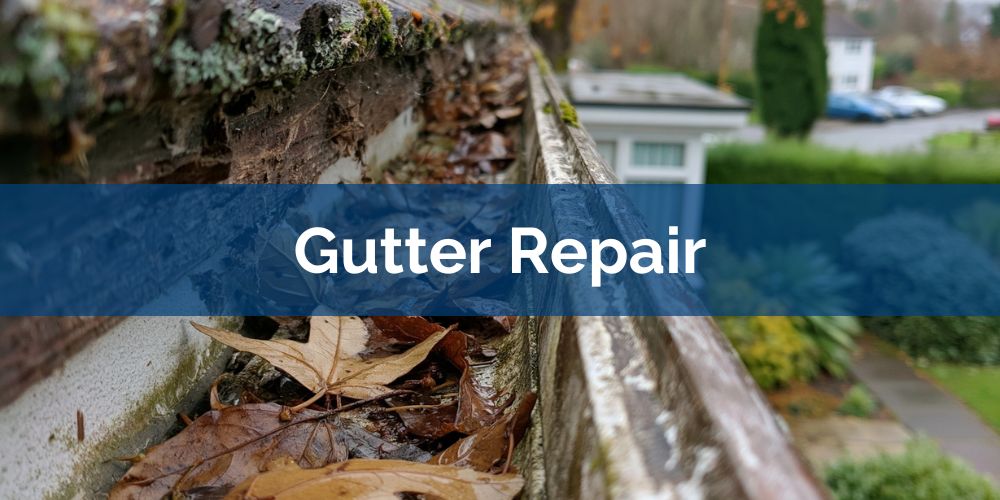
Raynes Roofing provides gutter repair in Woking for leaking joints, overflowing gutters, sagging sections, damaged fittings, blocked outlets and defective downpipes. Repairs can range from correcting a single leaking joint to replacing damaged gutter sections or restoring the alignment and discharge route of a wider rainwater system.
A gutter problem should be diagnosed as part of the complete drainage pathway rather than from the visible leak alone. Rainwater must leave the roof, enter the gutter, travel towards an outlet, pass through the downpipe and discharge into the intended drainage system. A defect at any point can cause overflowing, dripping or water running down the building.
Roof runoff → gutter → outlet → downpipe → surface-water discharge.
The appropriate repair depends on whether the failure is caused by blockage, loss of alignment, a defective joint, physical damage or a problem further along the rainwater route. Raynes Roofing can address the main faults found on domestic guttering systems:
These faults can produce similar symptoms, so the repair should be based on the failed component rather than automatically sealing the point where water is seen dripping.
A gutter system collects rainwater from the roof edge and transfers it through outlets and downpipes to the property's surface-water drainage route. Each component therefore depends on the next component remaining capable of accepting the water delivered to it.
The drainage chain can be divided into four functions:
Approved Document H to the Building Regulations covers rainwater drainage as part of drainage and waste disposal requirements in England.
The practical consequence is important: a gutter can appear to be overflowing because the gutter itself is defective, because its outlet is blocked or because the downstream rainwater route cannot accept water correctly.
A leaking gutter normally indicates loss of watertightness at a joint or fitting, physical damage to the gutter, displacement of the system or water escaping because normal flow has been obstructed.
The location of the leak helps narrow the cause:
This creates a better diagnostic sequence than applying sealant wherever dripping is visible:
leak position → component inspection → cause → repair.
Gutter overflow occurs when rainwater reaches a section faster than it can move through the intended drainage route. The restriction can be within the gutter, at the outlet, inside the downpipe or, in some cases, further into the surface-water system.
Common mechanisms include:
Woking sits within Surrey's wider surface-water management framework. Surrey County Council is the lead local flood authority responsible for managing risks from surface water, groundwater and ordinary watercourses, while Woking Borough Council directs residents to the appropriate authority for different flooding and drainage problems.
For an individual property, however, gutter repair should remain focused on the building's own drainage sequence and the specific restriction causing the overflow.
A sagging gutter has lost the intended line between its supports. This can create a low point where rainwater and debris collect instead of continuing towards the outlet.
Possible causes include:
The repair should therefore identify whether the gutter itself is damaged or whether the support behind it has failed.
Gutters need to direct water towards their designed outlets, so alignment and fall should support drainage rather than create unintended low points. A gutter that visibly drops between brackets or retains water away from an outlet may require adjustment even when it is not physically cracked.
The important distinction is between an intentional drainage arrangement and accidental sagging:
controlled alignment → water reaches outlet;
local sag → water collects away from outlet;
backfall → water travels towards the wrong end of the run.
A repair can therefore involve repositioning brackets and gutter sections rather than replacing the complete system.
A leaking gutter joint should be inspected to determine whether the problem lies with the fitting, seal, gutter position or the condition of the adjoining sections.
A repair can follow this sequence:
Simply applying sealant around the outside of a failed joint can leave the actual fitting or alignment problem unchanged.
Yes. Local gutter repair is appropriate where the failed component can be isolated and the surrounding gutter system remains serviceable.
Examples include:
failed joint + sound adjoining gutter → repair or replace joint;
single damaged bracket + stable gutter → replace support;
short cracked section + compatible surrounding system → replace local section;
local blockage + otherwise functional system → clean and restore flow.
Complete replacement becomes more appropriate when defects occur throughout the run or when remaining components would provide a poor basis for continued local repairs.
Gutter replacement should be considered when deterioration is distributed across the system rather than confined to a repairable fitting or section. The decision should be based on what would remain after the repair, not merely the number of visible leaks.
Replacement becomes more likely where:
The intervention hierarchy is therefore:
single defect → repair;
isolated damaged section → partial replacement;
distributed system failure → complete gutter renewal.
Gutter cleaning removes material obstructing an otherwise serviceable rainwater system. Gutter repair corrects a physical or functional defect in the system itself.
The two services solve different causes:
leaves or moss blocking water → cleaning;
failed joint allowing water out → repair;
loose bracket causing sagging → repair;
blocked outlet → cleaning or blockage removal;
cracked gutter section → repair or replacement.
Cleaning can expose defects that were previously concealed by debris, but it should not be presented as a repair where the gutter remains damaged after the obstruction has been removed.
Yes. A gutter can be completely clear and still overflow if its downpipe is obstructed. The downpipe is downstream of the gutter outlet, so a blockage prevents water from leaving at the rate required.
The diagnostic pathway is:
overflow near outlet → check gutter → check outlet → check downpipe → investigate downstream drainage if necessary.
A blocked downpipe can result from compacted organic debris, material entering through the outlet or another obstruction within the pipe. The blockage should be distinguished from a leaking or displaced downpipe joint because one restricts flow while the other allows water to escape from the pipe.
Downpipe repairs restore the vertical part of the rainwater system between the gutter outlet and the intended discharge point.
Common work can include:
A downpipe should therefore be assessed at both ends. A sound pipe connected to a blocked drainage route can still fail to remove rainwater effectively, while a clear drain does not correct a leaking pipe joint above it.
Persistent gutter leakage or overflow can repeatedly wet surfaces that the rainwater system is intended to bypass. The resulting problem may therefore extend beyond the gutter fitting itself.
The pathway can be:
gutter defect → uncontrolled water discharge → repeated wetting of fascia, wall or adjoining construction.
Where the supporting fascia has deteriorated, simply installing a new bracket into the same weak area may not provide a durable repair. The support should be assessed before the gutter is reinstated.
Likewise, staining on a wall beneath a gutter does not by itself establish whether the cause is an overflowing gutter, a leaking joint, a roof-edge defect or another source of moisture. The water route should be confirmed before repair.
Yes. The gutter and roof edge operate together, so water appearing behind or beyond a gutter does not automatically mean the gutter is defective.
Investigation may need to distinguish between:
This distinction prevents replacement of guttering that is merely receiving water incorrectly from a separate roof defect.
Repeated gutter blockage indicates that debris is entering the system faster than it is being removed or that part of the drainage arrangement is trapping material.
Common contributors include leaves, moss released from the roof covering, organic debris accumulating in low points and restricted outlets where material becomes concentrated.
Properties close to trees can require more frequent inspection because leaves and other organic material can enter roof drainage systems. Woking Borough Council maintains extensive controls relating to protected trees and trees within conservation areas, so vegetation management itself can sometimes be subject to separate restrictions.
The roofing response should remain proportionate: clear the obstruction, determine whether the gutter retains appropriate alignment and investigate repeated blockage at the same outlet if the problem continues.
Yes, where compatible components are available and the adjoining guttering remains serviceable, a damaged section can often be replaced without renewing the entire run.
A local section replacement requires more than matching colour. The new component must integrate with the existing gutter profile, fittings, joints, brackets and drainage direction.
The repair boundary should therefore satisfy three conditions:
If these conditions cannot be achieved with the retained gutter system, extending the replacement area can be more reliable than forcing an incompatible local repair.
A gutter assessment should identify where water stops following its intended drainage route. This turns visible symptoms into a defined repair scope.
Symptom → flow restriction or physical defect → affected component → repair scope.
Ordinary repairs, maintenance and very minor drainage work will not usually require planning permission. Planning Portal guidance states that planning permission is generally not required for repairs, maintenance and very minor work to drains and drainage systems.
Additional consideration can arise where a project materially alters a protected building or involves wider changes rather than simple like-for-like repair. This is locally relevant because Woking Borough Council identifies 27 conservation areas with special architectural or historic interest and maintains records relating to listed buildings.
The practical distinction is:
replace or repair a defective gutter component like-for-like → normally maintenance;
materially alter drainage or the external character of a protected property → check the applicable requirements.
A gutter contractor should distinguish defects in the above-ground rainwater system from problems within underground drainage or a soakaway.
The boundary is:
gutter + outlet + downpipe → above-ground rainwater system;
below-ground pipework + soakaway or other drainage → downstream surface-water system.
If water flows freely through the gutter and downpipe but backs up at ground level, the restriction may no longer be within the guttering itself. Planning Portal guidance also treats new rainwater drains and underground drainage as a distinct Building Regulations issue from routine maintenance.
This distinction prevents repeated cleaning or alteration of a functioning gutter when the actual obstruction lies beyond it.
Guttering should be checked where roofing work could have disturbed the roof edge, introduced debris or changed how rainfall reaches the existing drainage system.
Relevant checks include:
The final roof and gutter should therefore be considered as connected components rather than independent trades.
Raynes Roofing assesses gutter faults from the roof edge through to the downpipe rather than treating every drip or overflow as the same problem. The required work can range from clearing one blocked outlet or repairing a leaking connection to realigning a gutter run or replacing damaged sections.
Because Raynes Roofing also carries out roof repairs, an apparent gutter defect can be distinguished from problems at the roof edge, tiles, felt, fascia or adjoining roofing details where necessary.
The repair decision follows the condition found:
blockage → clear;
failed connection → repair;
poor alignment → adjust;
damaged component → replace locally;
widespread failure → renew the affected gutter system.
If your gutters are leaking, overflowing, sagging, blocked or pulling away from the property, contact Raynes Roofing for gutter repair in Woking. The rainwater system can be assessed to identify whether the problem lies with the gutter, joint, bracket, outlet, downpipe or adjoining roof detail and determine the appropriate repair.
Call 01483 475141 or contact Raynes Roofing to arrange an assessment.