
I agree Our site saves small pieces of text information (cookies) on your device in order to deliver better content and for statistical purposes. You can disable the usage of cookies by changing the settings of your browser. By browsing our website without changing the browser settings you grant us permission to store that information on your device.
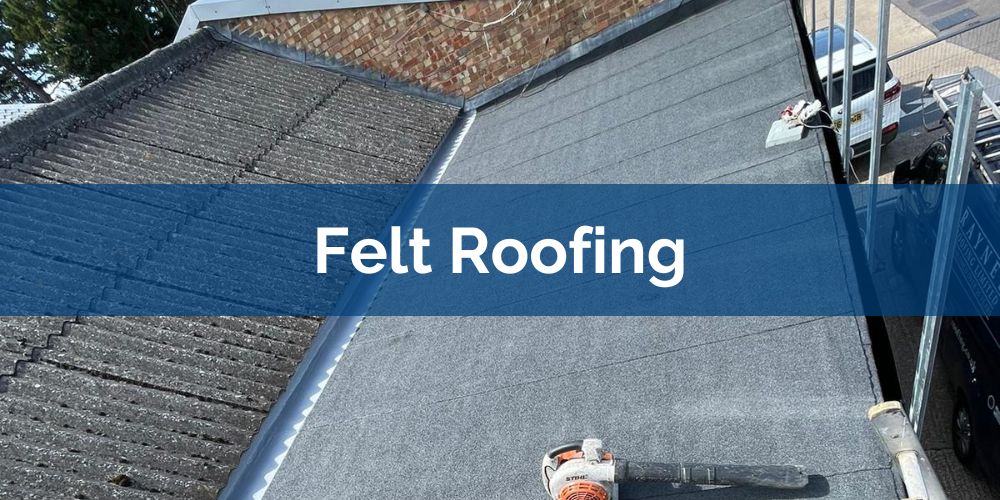
Raynes Roofing provides felt roofing in Woking for flat and low-slope roofs requiring new installation, repair, overlay or complete replacement. Operating from Knaphill, Woking, Raynes Roofing works on felt roofs covering extensions, garages, dormers, porches, outbuildings and suitable commercial roof areas across Woking and the surrounding area.
Modern professional felt roofing is more accurately described as reinforced bitumen membrane roofing. Unlike lightweight shed felt, reinforced systems use purpose-designed bituminous membranes to create a continuous waterproof roof covering. Reinforced bitumen systems are principally used on flat and low-slope roofs and are available in different specifications and installation methods.
The correct felt roofing solution depends on more than the visible membrane:
Woking property + existing roof construction + deck + insulation + falls + drainage + reinforced bitumen system + critical details → complete felt roof specification.
Felt roofing in Woking is installed across a varied residential and commercial building environment rather than one uniform type of property. Woking's own local-context material records continued development of areas including Goldsworth Park, Horsell, Knaphill and Old Woking from the 1970s onwards, alongside earlier parts of the borough and more recent development elsewhere.
That mixed development history matters to felt roofing because flat roofs are frequently additions to the original building rather than part of one standard construction. A garage, dormer or rear extension can therefore have a substantially different age, deck, insulation arrangement and waterproofing history from the main Woking property.
Several local relationships are particularly relevant:
Woking determines the property and local planning context; the individual roof determines the felt roofing specification.
Felt roofing is a waterproofing method using reinforced bituminous membranes installed across a suitable roof substrate to form a continuous weather-resistant covering. Modern reinforced bitumen systems combine reinforcement with modified bitumen to provide mechanical strength, dimensional stability and waterproofing performance.
A complete felt roof can include more than one membrane layer together with components such as:
The visible felt is therefore only the external waterproofing component of the roof assembly.
The reinforced bitumen systems normally meant by professional “felt roofing” are predominantly used as waterproof coverings on flat and low-slope roofs. IKO describes torch-applied reinforced bitumen membranes as being used predominantly on flat and low-slope roofs.
This needs to be distinguished from roofing underlay beneath tiles or slates on a pitched roof. Both products can be referred to informally as “felt”, but they perform different functions:
reinforced bitumen felt roof → primary external waterproof covering;
pitched-roof underlay → secondary layer beneath tiles or slates.
Raynes Roofing's felt roofing service should therefore not be understood as recommending exposed flat-roof membrane simply because felt is inexpensive. The system needs to be appropriate to the roof pitch, construction and intended waterproofing function.
The required service depends on whether the Woking roof is new, locally defective, suitable for retention beneath a new covering or deteriorated sufficiently to require replacement.
These terms should remain distinct:
repair → correct a local defect;
overlay → retain a suitable existing roof beneath new waterproofing;
replacement → remove components that are no longer suitable to remain.
Reinforced bitumen felt can be suitable for many flat and low-slope roof areas found on Woking properties, but suitability is determined by the roof construction rather than the building label alone.
Common applications include:
In Knaphill, Horsell, Goldsworth Park, Old Woking and elsewhere across the Woking area, the same term “felt roof” can therefore describe materially different constructions because these areas contain development from different periods.
A felt system should be selected from the conditions of the roof rather than from a generic specification applied to every Woking property.
The membrane selection therefore comes after the roof conditions have been established, not before.
Modern reinforced bitumen roofing is a family of systems rather than one universal roll of roofing felt. Manufacturers offer different reinforced membranes, build-ups and application methods for different roof conditions. IKO currently lists multi-layer reinforced bitumen systems alongside self-adhesive and flame-free options.
The installation approach can include:
The appropriate installation method depends on the manufacturer specification, substrate, building construction, detailing and site risk.
No. Torch-on felt is one method of installing reinforced bitumen membrane, not a synonym for every professional felt roof.
Torch application uses controlled heat during installation of the membrane. Reinforced bitumen roofing is also available using self-adhered and flame-free methods.
The distinction matters on existing Woking properties because roof geometry can bring waterproofing close to walls, timber details, rooflights and other construction where the installation method forms part of the risk assessment.
System suitability + substrate + detail geometry + installation risk → application method.
A professional felt roof is installed as a sequence of substrate preparation, roof build-up, reinforced membrane application and waterproof detailing.
On a Woking extension or dormer, these interfaces can occupy a significant proportion of the roof. The quality of the field membrane alone therefore does not determine whether the completed roof is weatherproof.
A felt roof requires a controlled route that directs rainfall towards an outlet or gutter. Flat roofing does not mean intentionally constructing a roof with no drainage direction.
The functional sequence is:
rainfall → roof falls → gutter or outlet → downpipe → intended surface-water route.
This has a genuine local relationship in Woking because the borough maintains dedicated water-management and drainage guidance, while local drainage planning policy is informed by the Strategic Flood Risk Assessment.
A felt roof cannot control wider flood risk, but the roof itself should reliably collect rainfall and transfer it into the property's intended rainwater system.
Persistent standing water should trigger assessment of the roof falls, outlets and local deck geometry rather than being treated as a waterproofing issue alone.
The diagnostic pathway is:
water remains after rainfall → identify low point → check outlet and drainage → assess membrane condition → determine whether drainage correction is required.
A membrane can remain watertight while the roof has a drainage defect. Conversely, persistent retained water can expose existing weak seams and details for longer periods and make an already deteriorated roof more vulnerable.
Replacing damaged felt without addressing the reason water collects can reproduce the same drainage condition on the replacement roof.
A felt roof can fail through the main membrane, but many water-entry routes occur where the continuous waterproofing changes direction, terminates or is interrupted.
Areas requiring particular attention include:
The point where water becomes visible internally is not necessarily directly beneath the external failure because moisture can travel within the roof build-up.
Felt roof failure can develop through the membrane itself, its supporting construction, its drainage system or the interfaces connecting it to the rest of the building.
The repair should therefore address the mechanism:
symptom → failure route → affected components → appropriate felt roofing intervention.
A leaking felt roof should be assessed from the internal symptom back through the waterproofing and drainage system rather than assuming the visible ceiling stain identifies the external defect.
This produces a condition-led repair scope rather than a patch sized around the internal damp mark.
A felt roof can normally be repaired where the defect is localised and the surrounding membrane and roof construction remain suitable for retention.
Repair candidates can include:
The decision can be reduced to:
local defect + sound surrounding felt + sound substrate → repair.
If investigation shows that the same membrane is failing throughout the roof, the problem has moved beyond a local repair condition even if only one area is currently leaking internally.
Replacement becomes more appropriate when deterioration is distributed across the felt roof or components beneath it can no longer be reliably retained.
Indicators include:
The replacement threshold is therefore:
isolated failure → repair;
broader surface failure + suitable retained construction → consider refurbishment or overlay;
widespread failure + unsuitable retained components → replacement.
New reinforced bitumen roofing can sometimes be installed over an existing roof, but only where the retained construction provides a suitable basis for the new system.
Before overlaying an existing Woking felt roof, the assessment should consider:
Overlay is therefore not simply “another layer of felt”.
Suitable retained roof + compatible new system → overlay may be possible.
Wet, unstable or incompatible retained roof → strip to the appropriate level before replacement.
Existing felt should be removed where the material beneath it needs to be exposed, assessed or replaced before a dependable new roof can be constructed.
Reasons can include:
This can matter particularly on Woking roofs that have been altered or extended at different times. The top membrane does not necessarily reveal the construction beneath it, and older roofs can contain several generations of previous intervention.
A defective roof deck should be repaired or replaced before the new felt system is completed because the waterproofing depends on a stable substrate beneath it.
The deck assessment resolves into:
sound deck → retain;
isolated deterioration → replace locally;
widespread deterioration → broader deck renewal;
possible structural failure → further assessment before roofing continues.
Applying a new waterproof membrane over a deteriorated substrate can hide the defect without restoring the roof assembly.
Substantial replacement of an insulated flat roof can require consideration of the roof's thermal performance rather than replacing only the waterproof membrane. Planning Portal guidance states that where a flat roof with integral insulation is replaced, upgrading the thermal element may be required.
This is particularly relevant to Woking extensions and other occupied flat-roof spaces because added insulation can increase the completed roof height relative to:
The correct sequence is therefore:
thermal requirement → insulation thickness → finished roof level → revised waterproofing and drainage details.
A warm felt roof is a roof in which the main insulation is located above the structural deck and the reinforced bitumen waterproofing is installed above the thermal layer.
The two terms describe different aspects of the roof:
warm roof → thermal arrangement;
felt roof → waterproofing technology.
A felt roof can therefore be specified as part of an appropriate warm-roof build-up rather than treating insulation as an unrelated component added beneath the waterproofing later.
A rooflight interrupts the continuous field membrane and creates an additional perimeter that must be integrated into the felt waterproofing.
On Woking extensions and dormers, a rooflight can occupy a significant proportion of a relatively small flat roof. The replacement or repair should therefore assess:
A rooflight leak should not automatically be diagnosed as failed glazing or failed felt. The interface between the two needs to be inspected.
Many domestic felt roofs cover additions to an existing building, so their most important details occur where the newer roof meets the original property.
These interfaces can include:
The Woking property context therefore matters because the waterproofing cannot be designed solely from the dimensions of the flat membrane:
existing building geometry + available upstand + roof level + membrane system → junction detail.
The age of a Woking house should not be assumed to be the age of its felt roof. Woking's local-context material records continued expansion of Goldsworth Park, Horsell, Knaphill and Old Woking from the 1970s, alongside more recent development elsewhere.
Flat roofs may have been added during later alterations, so an established property can contain:
original house + later extension + later replacement felt + subsequent patches.
Conversely, a more recent property can have a modern insulated flat roof where disturbing the membrane without understanding the complete system would be inappropriate.
The inspection should therefore date and assess the roof construction being worked on, not infer its specification from the age or appearance of the surrounding house.
Routine repair or like-for-like renewal will usually create fewer planning issues than work that materially changes the external appearance of a roof. Planning Portal states that re-roofing that does not change the external appearance will usually not require a planning application, subject to the relevant conditions and limits.
Woking has an additional local consideration because the borough contains 27 conservation areas where national and local policies provide extra controls over development and change.
The practical distinction is:
local felt repair → normally maintenance;
like-for-like re-covering without material external change → usually no planning application;
change to roof form, height or prominent external detail → check planning requirements;
conservation-area or listed property → check the property's specific constraints before material alteration.
Woking Borough Council also maintains information on listed buildings within the borough, which receive statutory protection against changes affecting their special character.
The regulatory position depends on the scale and nature of the felt roofing work. Planning Portal states that repairs or re-covering of an existing pitched or flat roof will not normally require a building control application in limited circumstances.
The position can change when the project extends into substantial re-roofing or replacement of the thermal element. Planning Portal specifically notes that replacement of a flat roof containing integral insulation can require an insulation upgrade.
The relevant scope boundary is:
local membrane repair → normally repair;
broader felt renewal → assess the extent of re-roofing;
replacement of insulated roof build-up → thermal requirements may apply;
structural deck alterations → additional Building Regulations considerations can arise.
The requirement should therefore be determined from the work proposed on the individual Woking property rather than from the word “felt”.
There is no single accurate lifespan for every felt roof because reinforced bitumen systems differ in specification, certification, installation and intended service life. IKO, for example, currently lists reinforced bitumen systems with different BBA-certified service-life and guarantee periods rather than treating every felt product as equivalent.
Performance also depends on:
A headline age should therefore not determine whether a Woking felt roof requires replacement. Its actual condition and the remaining serviceability of the roof assembly are more useful.
Yes. Inspection and maintenance can identify local deterioration while the surrounding membrane remains serviceable.
Relevant checks include:
The inspection should resolve into a decision:
no defect → continue monitoring;
local defect → repair;
distributed deterioration → assess refurbishment;
failed retained construction → consider replacement.
Local storm or impact damage can often be repaired where the affected membrane can be isolated and the surrounding felt remains serviceable.
The inspection should determine:
The repair boundary should follow the damage rather than simply covering the visible puncture.
A felt roof moves beyond local repair when the membrane or construction that would remain after patching is no longer capable of supporting a dependable waterproof solution.
Broader intervention becomes appropriate where:
The correct comparison is therefore:
condition remaining after repair versus condition remaining after refurbishment or replacement.
The completed felt roof should be inspected across the waterproofing and drainage system rather than only across the central membrane surface.
Completion checks can include:
The completed roof should resolve the same pathway established during specification:
stable roof construction → reinforced bitumen waterproofing → correctly formed interfaces → effective drainage → weatherproof building.
Raynes Roofing operates from Knaphill, Woking and provides felt roofing across Woking and surrounding areas. Work can range from a small local repair to a garage or extension through to complete renewal of a larger flat or low-slope felt roof.
Woking's development pattern means the actual construction can differ materially between properties and roof areas. Goldsworth Park, Horsell, Knaphill and Old Woking, for example, have all experienced different phases of development and expansion.
The service is therefore not based on one Woking specification:
local property context + roof age + deck + existing membrane + insulation + drainage + details → repair, overlay or replacement scope.
Raynes Roofing is based in Knaphill and can assess a felt roof against the alternatives of local repair, overlay, refurbishment and complete replacement before the scope is determined.
This allows the intervention to follow the roof condition:
isolated defect → repair;
suitable retained roof + broader waterproofing requirement → consider overlay;
widespread membrane failure → replacement;
damaged deck or roof build-up → reconstruct affected components before new waterproofing.
Raynes Roofing has been established for more than 45 years and offers guarantees covering its roofing workmanship and applicable roofing materials.
If you need a new felt roof, have a leaking reinforced bitumen roof or need to determine whether an ageing felt roof should be repaired, overlaid or replaced, contact Raynes Roofing for felt roofing in Woking.
The existing roof can be assessed to identify the waterproofing system, determine the condition of the membrane and retained construction, assess drainage and critical details, and establish the appropriate felt roofing scope.
Call 01483 475141 or contact Raynes Roofing for advice or a quotation for felt roofing in Woking.