
I agree Our site saves small pieces of text information (cookies) on your device in order to deliver better content and for statistical purposes. You can disable the usage of cookies by changing the settings of your browser. By browsing our website without changing the browser settings you grant us permission to store that information on your device.
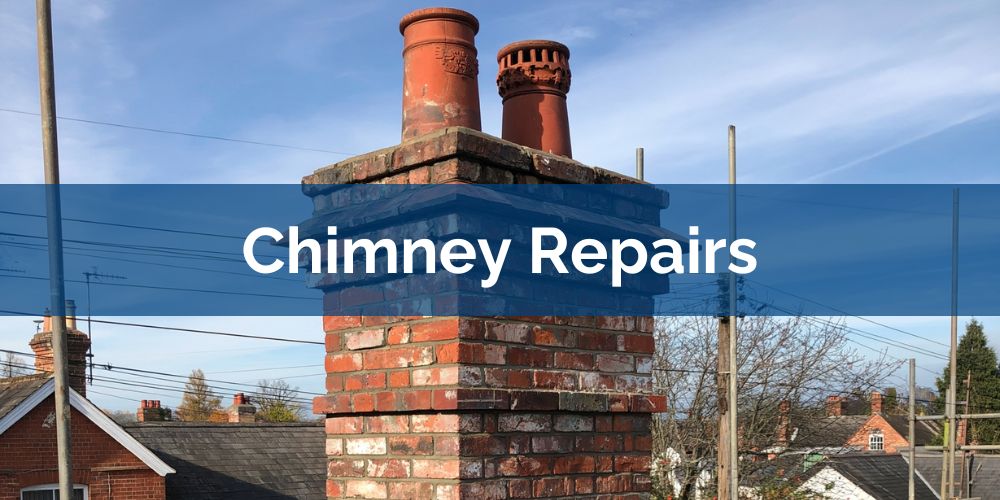
Raynes Roofing provides chimney repairs in Woking for leaking, deteriorated and damaged chimney stacks and the roof junctions surrounding them. Repairs can include chimney repointing, replacement brickwork, lead flashing and soaker work, repairs to back gutters and front aprons, flaunching repairs, chimney pot reseating, cowl and vent installation, partial rebuilding and complete chimney rebuilding where local repairs are no longer sufficient.
A chimney problem should be diagnosed by identifying which component has failed rather than treating every leak or visible crack as the same defect. A chimney stack combines exposed masonry, mortar joints, terminal details and a weatherproof junction with the roof, so water entering near a chimney does not automatically mean the brickwork itself is responsible.
Symptom → chimney inspection → failed component → extent of deterioration → repair, rebuild or removal.
The appropriate chimney repair depends on whether deterioration affects the masonry stack, mortar joints, chimney top or the junction between the chimney and roof. Raynes Roofing can address the principal defects found around domestic chimney stacks:
These are separate repair mechanisms rather than interchangeable treatments. Repointing cannot correct a failed lead flashing, while replacing flashing will not stabilise extensively deteriorated masonry.
Chimney stacks are highly exposed parts of a building because they project above the roof and contain multiple interfaces between masonry, mortar, pots, flashings and the roof covering. Deterioration can therefore develop through several independent mechanisms.
The repair should therefore follow the failed component:
mortar failure → repoint;
local brick failure → replace masonry;
roof-junction failure → repair leadwork;
top-of-stack failure → repair pots or flaunching;
widespread instability → rebuild or consider removal if the chimney is redundant.
A chimney leak is diagnosed by distinguishing defects in the chimney masonry from defects where the chimney passes through the roof. Damp appearing beside a chimney breast does not by itself identify which component has allowed water into the building.
This prevents a common diagnostic error:
water beside chimney ≠ automatically defective chimney pointing.
A sound masonry stack with failed flashing requires a roof-junction repair. A correctly installed flashing cannot compensate for severely defective masonry immediately above it.
Chimney repointing removes deteriorated mortar from the joints between bricks and replaces it with suitable new mortar while retaining serviceable masonry.
Repointing is appropriate where the joints have deteriorated but the bricks and overall stack remain suitable for continued use. It is not intended to conceal loose masonry or simply cover old mortar with a thin new surface layer.
The basic repair relationship is:
deteriorated mortar + sound bricks → repoint;
deteriorated mortar + isolated damaged bricks → replace affected bricks and repoint;
widespread masonry instability → consider partial or complete rebuilding.
The repair boundary should extend through the deteriorated joint to suitable retained material so the new pointing forms part of a coherent masonry repair rather than a cosmetic coating.
A chimney becomes a repointing candidate when mortar joints have deteriorated but the masonry units and overall stack remain sufficiently stable to retain.
Signs that warrant assessment include:
Visible mortar deterioration should still be distinguished from defects elsewhere. If the leak originates at a failed back gutter, repointing sound or moderately weathered joints will not correct the actual water-entry route.
Individual chimney bricks can be replaced where deterioration is localised and enough sound surrounding masonry remains to retain the stack.
Brick replacement can become appropriate where individual units are fractured, substantially deteriorated or no longer provide an appropriate base for repointing.
The intervention should remain proportional:
sound brick + failed joint → retain brick and repoint;
isolated defective brick → replace affected unit;
multiple defective bricks within one area → local masonry reconstruction;
distributed structural deterioration → assess whether the stack requires rebuilding.
This avoids replacing sound historic or existing masonry unnecessarily while also avoiding new mortar being installed around bricks that no longer provide a serviceable repair boundary.
The junction between a chimney and a pitched roof normally requires a series of weathering details that direct rainfall around the masonry and back onto the roof covering. Different parts of the chimney interface perform different functions.
The components operate as one drainage junction:
rainfall above chimney → back gutter → side weathering → roof covering below.
A defect in one part can therefore create a leak even when the rest of the leadwork remains serviceable.
Chimney flashing can leak where the lead detail becomes displaced, damaged, inadequately integrated with surrounding roofing or loses its weatherproof connection with the masonry.
The repair should establish which interface has failed:
lead-to-masonry junction → check how flashing is secured and weathered;
lead-to-roof junction → check integration with tiles, slates and soakers;
upslope chimney face → inspect back gutter;
downslope chimney face → inspect apron;
damaged lead itself → determine whether local repair or replacement is appropriate.
Replacing one visible strip without understanding the complete junction can leave an adjoining failure untouched.
A chimney back gutter is the weatherproof channel located on the upslope side of a chimney where rainfall travelling down the roof meets the stack. Its function is to collect that water and divert it around the sides of the chimney so it can continue down the roof.
This position is particularly important because the chimney interrupts the natural drainage route of the roof:
roof runoff → chimney obstruction → back gutter → water diverted around stack → roof continues drainage.
A defective back gutter can allow water into the roof junction even when the visible pointing on the front and sides of the chimney appears satisfactory.
Soakers are weatherproofing pieces installed in conjunction with individual courses of tiles or slates at appropriate roof-to-wall or roof-to-chimney junctions. They work beneath the visible side flashing to prevent water moving through the stepped junction between the roof covering and masonry.
This creates two related but distinct layers:
soaker → integrated with individual roof-covering courses;
side flashing → protects the junction between soakers and chimney masonry.
A chimney-side leak can therefore require investigation beneath the visible flashing rather than assuming the outer leadwork is the only relevant component.
Flaunching is the mortar or similar formed material around the chimney pots at the top of a traditional masonry stack. It supports and weathers the area around the pot bases while helping direct water away from the top of the stack.
Flaunching can require repair where it becomes:
The pot and flaunching should be assessed together. Applying fresh material around a pot that is already unstable does not resolve the underlying fixing problem.
A loose chimney pot can often be reseated where the pot itself remains suitable and the surrounding chimney top can provide a sound rebuilt detail.
The repair should establish:
A damaged pot should be replaced rather than merely surrounded with new mortar.
Raynes Roofing can install suitable chimney cowls and vents where these form part of the required chimney repair or redundant-flue arrangement. The correct terminal depends on what the flue serves and whether it remains operational.
A cowl, cap and ventilation arrangement should not be treated as interchangeable components. Where a chimney continues to serve an appliance, the terminal and flue requirements need to remain appropriate to that installation. Where a chimney is permanently redundant, the objective may instead be to protect the opening while maintaining whatever ventilation strategy is appropriate for the retained flue.
The relevant first question is therefore:
active flue or redundant flue?
That determines the terminal requirement before a particular cowl or vent is selected.
Chimney rebuilding becomes more appropriate when deterioration extends beyond components that can be reliably repaired in place.
Rebuilding should be considered where:
The repair hierarchy becomes:
joint deterioration → repoint;
isolated brick failure → local brick replacement;
local unstable section → partial rebuild;
widespread stack failure → complete rebuild or removal assessment.
A rebuild should therefore be triggered by the condition of the masonry that would otherwise remain, not simply by the age of the chimney.
A redundant chimney can still be repaired and retained, but removal becomes a reasonable alternative where the stack has no continuing function and requires substantial or recurring maintenance.
The decision should consider:
The two services should remain clearly differentiated:
chimney repair → retain stack and restore defective components;
chimney removal → dismantle stack and reconstruct the roof where it previously penetrated it.
Yes. Partial rebuilding can be appropriate where deterioration is concentrated in the upper section and the masonry below remains stable and suitable for retention.
The repair boundary should be established at sound masonry rather than at an arbitrary number of brick courses:
deteriorated upper section → dismantle to stable masonry → rebuild affected section → reinstate pots and top detail.
If deterioration continues substantially below the proposed rebuilding level, extending the repair or reconsidering complete reconstruction can provide a more coherent result than rebuilding onto a weak base.
Routine like-for-like chimney maintenance and repair will generally create fewer planning issues than materially altering or removing a chimney. Planning Portal states that fitting, altering or replacing an external chimney is normally capable of being permitted development where the applicable limits and conditions are satisfied.
Local constraints still need to be considered because Woking has 27 conservation areas recognised for their special architectural or historic interest. Woking Borough Council also maintains information on statutory and locally listed heritage assets.
The practical distinction is:
like-for-like maintenance → normally straightforward repair;
material alteration to chimney form or appearance → check planning requirements;
listed building or heritage-sensitive property → establish the applicable consent position before materially changing historic fabric.
A chimney can be technically repairable while the choice of materials, appearance or extent of alteration is separately constrained by the property's heritage status.
Local maintenance to pointing, masonry or weatherproofing does not automatically create a Building Regulations application, but wider structural work can change the position.
Planning Portal states that repairs to an existing roof will not normally require a building control application where the work remains below specified thresholds and does not trigger other relevant conditions.
The important boundary for chimney work is whether the project remains a repair or changes the building structurally:
local pointing or flashing repair → maintenance;
local masonry replacement → repair subject to actual scope;
significant structural alteration → assess Building Regulations requirements;
chimney breast or load-bearing alteration → structural requirements become directly relevant.
The applicable requirements should therefore be established from the proposed work rather than the general description “chimney repair”.
Chimney repairs combine work at roof level with masonry and materials positioned above the surrounding roof surface. Safe access and protection against falls and falling materials therefore form part of the repair method rather than an optional addition.
HSE states that all roof work is potentially dangerous and must be properly planned with suitable precautions against falls.
The appropriate access arrangement depends on:
A small visible defect does not necessarily mean the access requirement is equally small. The work still has to reach an exposed structure safely and control loose masonry or materials during repair.
The repair scope should extend far enough to remove the failed component and reconnect the new work to sound retained chimney and roofing materials.
This turns a broad request for “chimney repairs” into a defined intervention:
failed component + extent + retained condition → repair scope.
A chimney moves beyond local repair when the material that would remain after patching is no longer capable of forming a dependable stack.
Indicators include:
The decision is therefore:
repairable component failure → local repair;
defined unstable section → partial rebuild;
widespread failure + chimney still required → rebuild;
widespread failure + redundant chimney → compare rebuilding with removal.
A completed chimney repair should be considered across the components affected by the work rather than by visual appearance alone.
Relevant completion checks can include:
The purpose is to confirm that the individual repair has been reintegrated into the chimney and roof rather than leaving a corrected defect surrounded by disturbed adjoining components.
Raynes Roofing can assess chimney defects across both the masonry stack and the surrounding roofing junction. This allows a leaking chimney to be distinguished from failed leadwork, a loose chimney pot from defective flaunching, and local mortar deterioration from masonry that requires rebuilding.
The repair decision follows the component that has failed:
mortar → repoint;
brickwork → repair or rebuild;
leadwork → restore the roof junction;
pot or flaunching → repair the chimney top;
widespread failure → rebuild or consider removal.
Raynes Roofing has been established for more than 45 years and offers guarantees covering its roofing workmanship and applicable roofing materials.
If your chimney is leaking, mortar is deteriorating, brickwork is damaged, a chimney pot is loose or the leadwork around the stack has failed, contact Raynes Roofing for chimney repairs in Woking. The stack and surrounding roof junction can be assessed to determine whether the correct intervention is repointing, brick replacement, leadwork repair, chimney-top repair, partial rebuilding or complete reconstruction.
Contact Raynes Roofing for advice or a quotation for chimney repair work in Woking.